
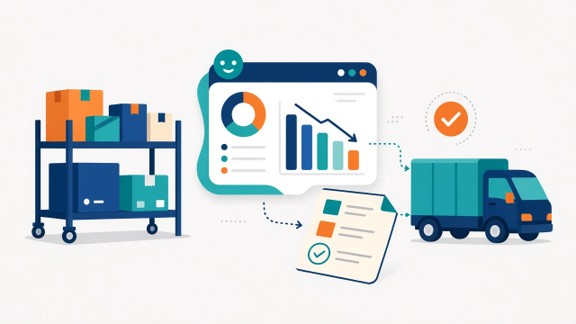
Reordering stock is one of those jobs that never ends. Check what is low, guess what will sell, raise the order, repeat.
This week, several inventory and distribution software companies said AI can now do more of that loop on its own. Not just suggest a reorder, but create the order.
That is useful. It also changes what matters most in your system. When software places the order, the quality of the numbers it reads becomes the whole game.
Inventory software that raises the purchase order itself
On November 9, Katana, an inventory platform based in Tallinn, Estonia, used by more than 1,500 companies in 70 countries, launched what it calls inventory that runs itself. It watches stock across channels and locations, flags items that will run out before a new order can arrive based on each item’s lead time, recommends what to reorder, and creates the purchase or manufacturing order. All of it runs on parameters each business sets, and people step in only for decisions that need them.
The same day, Pepper announced Dispatch, a workspace for AI agents used by food distributors. Its purchasing agents look at inventory, sales data and past buying patterns, including large holiday buys. Pepper says one distributor’s owner expects the tool to eventually handle 95% of his purchasing. That is one customer’s expectation, not a measured result.
A reorder is only as good as the record behind it
Katana makes an honest point in its own announcement: every business runs on rules nobody else shares, like what counts as available stock, and automation that does not know those rules will confidently do the wrong thing.
An automatic reorder reads current stock, open purchase orders, supplier lead times and sales history. If any of those is late or wrong, the system can order too much, too little, or too late, and do it with confidence.
GrubMarket’s launch on November 10 shows how common the gap is. Its new Purchase Order Agent turns vendor invoices, receipts, photos and spreadsheets into structured purchase orders for food distributors. GrubMarket explains why: when purchase orders are entered late, distributors lose sight of their costs and real inventory, sales teams cannot see what is available, and warehouse staff end up counting stock every day.
An AI that reorders based on a supplier lead time of two weeks will not help much if that supplier now takes five.
Decide what the system may buy without asking
Katana sends only the decisions that need a person. Pepper describes Dispatch as the place where your team reviews agent work and decides what agents handle on their own. In GrubMarket’s flow, a user reviews the extracted order before creating it in the ERP with one click.
So the real design question is where your line sits. A routine reorder of a fast-moving item from a reliable supplier is a good candidate to run on its own. A large seasonal buy, a new supplier, or a price jump probably is not.
Katana now also connects to Claude, ChatGPT and Gemini through MCP, so staff can check stock and draft orders from the AI tool they already use. That makes it even more important to know who can create an order, from where, and up to what amount.
Practical takeaways
Automatic reordering can save real time, but it moves the work from placing orders to keeping the inputs right.
- Review supplier lead times for your top items and update the ones that have changed.
- Make sure purchase orders are entered when goods are bought, not days later.
- Write down what counts as available stock in your business, including reserved and in-transit items.
- Set clear limits: which items, suppliers and order sizes can be raised automatically, and which need approval.
- Run suggestions in parallel with your current process for a few weeks before letting the system place orders.
If your system started placing orders tomorrow, which number would you trust least?
Sources
- Business Wire: Katana Launches Inventory That Runs Itself, With AI Replenishment and 150 New Warehouse Integrations (Nov 9, 2026)
- Katana: Inventory that runs itself (product page)
- PR Newswire: GrubMarket Launches AI Agent That Transforms Purchase Order Processing for Food Distributors (Nov 10, 2026)
- Pepper: Introducing Dispatch: Put AI Agents to Work Across Your Business (Nov 9, 2026)